Mala - Prayer Beads
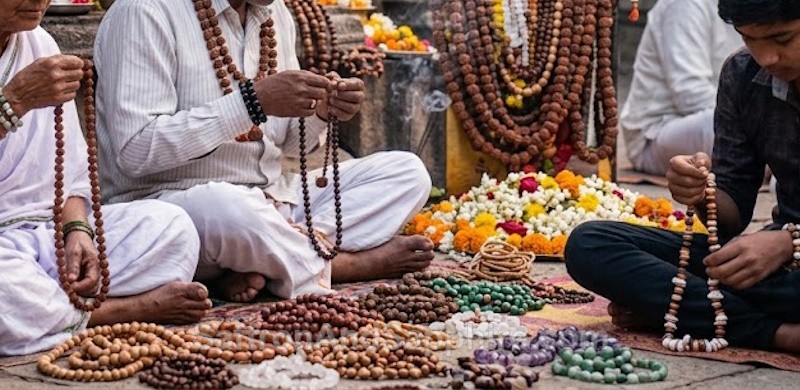
Mala or Prayer Beads
Tibetan Malas or Prayer Beads
Mala or Prayer beads are similar to rosary beads (108 in number), used for repetitive prayer (japa), a common aid to worship in Hinduism and Buddhism. Malas are used for keeping count while reciting, chanting, or mentally repeating a mantra or the name or names of a deity. This practice is known in Sanskrit as japa, when mantras are repeated hundreds or even thousands of times. The mala is used so that one can focus on the meaning or sound of the mantra rather than counting its repetitions. One repetition is usually said for each bead while turning the thumb clockwise around each bead .
The string of beads is mainly used to count repeated mantras. So actually, it serves the same purpose as a rosary. Beads made of semi-precious stones, pearls, bodhi seeds or wood may serve all kinds of goals, like counting any kind of mantras, or other forms of prayer, bows, walk-rounds and such. The cord is the same for every mala, and should be made of nine threads, symbolising the Buddha Vajradhara and the eight Bodhisattvas. The larger bead at the end stands for wisdom, realising emptiness, and the cylindrical bead on top of the large bead symbolises the void itself. Together, they symbolise the triumph over all adversities.
Mala
A mala originally is a Hindu and Buddhist tool for prayer and meditation. It is used to count mantras during meditation. A mantra is a collection of words, often from Sanskrit, which is repeated several - traditionally 108 - times. While repeating, you focus on the meaning and vibration of the words, possibly combined with the accompanying visualisation. By training in a meditation practice like this, your thoughts come to rest and your body relaxes. Nowadays, a mala is also worn as a fashion accessory.
Why 108?
Malas have 108 beads because this number has great scientific significance in the Hindu and Buddhist traditions. The circumference of the sun times 108 is the distance between the sun and the Earth and the same is true for the moon and Earth. Also, there are 108 nadis or energy channels in the body. There are 54 sanskrit letters- both masculine and feminine, totaling 108. There are 108 Puranas and 108 Upanishads. The list goes on and on!! So that same sacred number is used in malas.
Materials
SANDALWOOD: fragrant and exceedingly smooth, sandalwood has traditionally been regarded as one of the purest substances and is valued for its cooling properties and its medicinal value - believed to promote tranquility, calmness and a positive frame of mind
RUDRAKASH: is the divine gift of Lord Shiva for the benefit of humanity. Rudraksha means "Tears of Rudra" (Lord Shiva); they are the holiest items with mystical powers. For thousands of years, people have been using the beads for obtaining spiritual, material and medicinal benefits. It is believed that one who wears Rudraksha is untouched by sins, and is protected from all negativity. The natural electromagnetic properties of the holy Rudraksha beads have been found to improve concentration, focus and mental stamina. According to Ayurvedic scriptures, wearing Rudraksha can have positive effects on the heart, nerves, and is good for relieving a person from stress, depression, anxiety, palpitations, high blood pressure. For the spiritual seeker this is a blessing in disguise, as the wearer of Rudraksha is able to achieve his/her goals faster; also, the effects of the rituals will be ten times more effective. Mala with 5 mukhi Rudraksha seeds.
Due to natural variation, the colour, size and shape of the Rudraksha seeds may vary.
BANYAN TREE: In Hinduism, it is linked to wisdom and divine knowledge, as it's said that Lord Krishna imparted the Bhagavad Gita to Arjuna under a banyan tree. The banyan tree (Vata Vriksha in Sanskrit, Ficus benghalensis in Latin) is sacred, symbolizing longevity, immortality, and shelter. It is associated with the Trimurti (Brahma, Vishnu, and Shiva) and is considered the "tree of life"
TULSI: Tulsi wood, which is in the Basil family, is the most sacred of all woods in the Hindu tradition. It is worshipped in Indian temples as a living goddess. One Hindu legend relates that Vishnu spawned Tulsi from the turbulent seas in order to help all of mankind. According to popular Indian belief, wherever Tulsi is planted, the place becomes sanctified as a place of pilgrimage and the sepoys (soldiers) of Lord Death dare not enter that place. In India, Tulsi is regarded as the most sacred plant. It is a much-branched, erect bushy plant of about 4 feet in height. Its leaves are aromatic and they have minute glands. The flowers are purple in small clusters and the seeds are yellow or red.
A Tulsi mala is prepared from the stems of the Tulsi (Holy Basil) plant. It is also a medicinal plant, which helps to balance vata and kapha. Tulsi helps to improve devotion and love in the heart.
Vaijayanti : The Vaijayanti or Vyjayanti is a theological flower, offered to Krishna and Vishnu in worship as a garland. It literally means "The Garland of Victory".
*Any healing properties outlined are in no way meant to replace diagnosis or treatment by a qualified therapist or physician. If in doubt about your health, consult a physician.
Made in India and Nepal - EU R.P.: Mani Bhadra NL

|

Also in: Meditation & Relaxation
 |  |  |  |  |
 |  |  |  |  |
 |  |  |  |  |